

A couple days back, I was watching this reel on Instagram that it took China 9 hours to rebuild a railway station, 28 hours to construct a 10-storey apartment block, 10 days to build a mobile cabin hospital. I personally couldn’t fathom that.
China built over 45,000 km of high-speed rail in just over 10 years. In comparison, it is taking India to make its first Bullet line of Mumbai-Ahmedabad (~508 Km) more than 10 years since it laid the foundation in 2017.
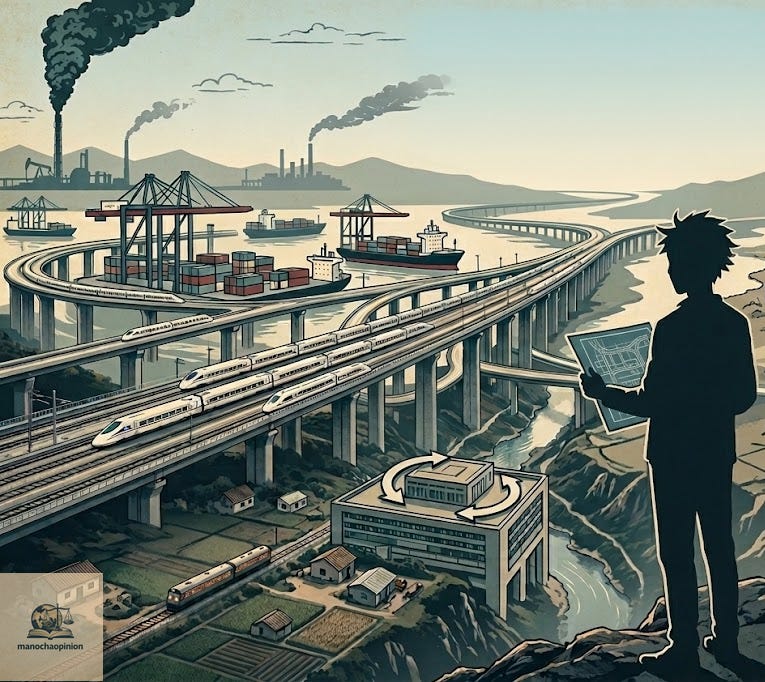
And it is not just India. USA, Canada, UK are all at a snails’ pace as compared to China.
We binge watch, they binge build.
Most Whatsapp groups or Facebook post would just attribute this to the authoritarian government, that democracy wouldn’t let development happen.
Indians, or any other country citizens, are the worst enemy of their old nation.
This is a common rhetoric but that’s a lazy answer. For a singular authoritarian China, there are manifold of authoritarian regimes that have made life hell for their citizens.
The real difference might be in the traits held by the people in the room.
An important distinctions was given by Dan Wang in his book Breakneck: China’s Quest to Engineer the Future, which is honestly a delight to read. There isn’t a single answer to the question about why China can move fast and why we can’t, but Wang offers one I haven’t heard before. He says one of the most important distinctions between the US and China is that the US is a society run by lawyers and China is a society run by engineers — and that many of our differences flow from this divide.
Dan Wang in a podcast with Sean Illing, had this to say about the difference between China and the USA
China, I argue, is an engineering state. At times, the entire Standing Committee of the Politburo, the country’s top leadership, was filled with trained engineers. Hu Jintao, for example, was a hydraulic engineer who supervised the building of a dam. His premier, Wen Jiabao, was a geologist. They approached society as if it were a giant technical problem, something to be solved like a hydraulic system or a math equation.
America, by contrast, began as a lawyerly society. The Declaration of Independence reads like a legal case. Many of the Founding Fathers were lawyers, and so were the vast majority of presidents up through Lincoln. Even today, lawyers are dramatically overrepresented in politics and business.
And this is the case with a lot of nations if you think about it. Skilled debaters rising into political power. Lawyers dominate not just politics but corporate leadership, too. Even President Donald Trump, though not a lawyer, governed in a lawyerly way — suing people constantly, using accusations in the court of public opinion.
Indian politicians are full of this trait. While many of India's early leaders (like Nehru or Ambedkar) were indeed trained as lawyers, their power didn't come from a "bill of particulars"—it came from moral authority and the mastery of the mass rally. Atal Bihari Vajpayee is a great example of the "Statesman-Poet", who used meter, metaphor, and silence. Narendra Modi does it a bit differently in the sense that he operates or tries to show it like he’s a grand architect. And because Indian leaders are Statesmen, they spend their energy building consensus and narrative. That wins elections but doesn’t gurantee growth.
In a lawyerly society, you are incentivized to follow the process. In China’s engineering state, you are incentivized to deliver the product. And in China, the local leaders are given a lot of freedom to experiment with as long as they reach the goals set by the Chinese Politburo, such as objectives for agricultural production or technological development.
All these changes came under Deng Xiaoping who believed in the power of the market forces, but under a socialist regime. He let go of hundreds of thousands of government officials so as to trim the fat. To encourage the market and private businesses, a competitive environment was encouraged where various cities and provinces vied to demonstrate the effectiveness of their specific development models. These successes became a component of political competition, as leaders sought to prove their capabilities to rise within the party hierarchy.
This was done to demonstrate power, so if, for example, the Gujarat model or the Telangana model works best, their leader should be made the national leader. Promotions are tied to GDP growth, infrastructure, targets. This also means that a lot of wasteful infrastructure and ghost cities will and have been created.
Activity = Success
So when multiple leaders are experimenting with various government regulations and models, the best ones emerge and end up being adopted by their fellow provinces as well. The speed we associate with China is not cultural or accidental, it is institutional.
I am going to go with the main factors of creating infrastructure, since it keeps it simplified while having enough depth in it.
Let’s start with the biggest cost of them all.
Land
In China, all land is ultimately owned by the state. This means that the system operates through land use rights rather than absolute private ownership. So while individuals or entities do not own the land itself in a legal sense, they possess the rights to utilize it. If you "own" a house in a Chinese city, you actually only own the Land Use Right (LUR)—usually for 70 years for residential or 50 years for industrial.
When the government wants to build a high-speed rail through a farm, they just cancel your land subscription.
This removes one of the biggest sources of delay seen around the world: fragmented ownership and negotiated acquisition. Local governments can reassign land for infrastructure with far fewer procedural hurdles. In India or the US, land acquisition is often the single biggest bottleneck, involving compensation disputes, legal challenges, and political negotiation across multiple stakeholders.
There is no such thing as NIMBY in China.
In democracies, infrastructure usually has to pass through a world of fragmented title, negotiated acquisition, consultation, compensation disputes, environmental review, and judicial challenge. India’s 2013 land acquisition law explicitly emphasizes a “humane, participative, informed and transparent process,” with Social Impact Assessment, consultation with local self-government institutions and Gram Sabhas, compensation, rehabilitation, and resettlement. Those protections are deliberate. But they also add time, veto points, and uncertainty.
The United States works through another rights-heavy model. The DOJ’s guidance on condemnation and land acquisition makes clear that eminent-domain proceedings are governed by strict legal procedure, and that just compensation is a constitutional requirement. Again, this is not bureaucratic clutter for its own sake. It is the legal expression of a system in which the state must justify taking land from rights-bearing owners and is subject to judicial process.
China’s model is different because all these procedures are nested inside a political economy where the state already has a much stronger claim over land allocation. That means fewer truly independent veto points.
But speed here is not free. While we have to appreciate the raw power and efficiency of this system, it’s created a massive dependency on land sales that’s now hitting a wall. Local governments in China are addicted to land sale to fund their budgets.
And as soon as the property market weakened, that land-sale revenue tanked, hitting local public finances hard. It’s a classic case of the “Engineering State” fixing one problem—the speed of land assembly—only to build an even bigger one: a total dependence on land finance and a reckless incentive to over-convert every acre in sight.
There is also a social cost. When local governments have strong incentives to convert land and strong institutional power to do so, displaced communities can end up with less bargaining power than they would have in more rights-heavy systems. China has tried to formalize compensation and procedural safeguards, but the balance of power remains very different from democracies where courts, elections, media, and civil society can more credibly block or delay projects.
Financing
China does not finance infrastructure the way most democracies do. It does not wait for projects to become fully “bankable” in the market sense before building them. Instead, it uses a state-directed financial system to push capital into projects that serve political and developmental goals. Infrastructure is largely funded through state-backed banks and local government financing vehicles (LGFV). Local government borrowing through official bond quotas, especially special-purpose bonds. China’s Ministry of Finance said that in the first half of 2023 alone, local governments issued 2.17 trillion yuan of new special bonds for project construction, funding nearly 20,000 projects. NDRC reporting has also emphasized the front-loading and acceleration of such special-bond issuance to support infrastructure.
This also means that the debt is huge - China's LGFV debt is estimated between US$7-11T by 2024. To put that in perspective, China’s entire GDP is around $19 trillion.
Now, a market-driven system, the kind that relies on private capital, rigorous viability assessments, and actual risk pricing, definitely looks more “pragmatic” in the long run. But it’s also much more fragmented here in democracies.
Infrastructure finance is usually a mix of public finance, sovereign borrowing, multilateral support, and private finance from investors and commercial lenders. It emphasizes bankability, legal frameworks, risk allocation, and project preparation.
It sounds like necessary procedures, but it has huge consequences.
Before capital arrives, the project often has to survive a gauntlet: budget approval, procurement rules, environmental review, consultations, legal challenge, tariff design, and sometimes electoral turnover. Even where the money is public, it usually moves through legislatures, audited budgets, and competing priorities.
Where the money is private, investors want clarity on returns, regulation, demand risk, and dispute resolution. Each of these steps is defensible on its own but they slow velocity.
Capital must usually pass through more veto points because financiers, regulators, elected officials, courts, and communities are genuinely separate actors.
China’s model has made execution dramatically faster. But it also means the system carries hidden debt. But you can’t deny that this debt-fueled sprint has given China a massive head start that’s rattled the global order. It’s a brilliant move, provided they don’t lose control of the math.
Labour
China’s ability to build quickly is also rooted in how it organizes labour. Its construction sector relies on a large, mobile workforce that can be deployed rapidly across projects, often working in parallel shifts to compress timelines. State-linked construction firms operate with standardized processes and established subcontracting networks, allowing them to scale execution without rebuilding teams from scratch each time.
In contrast, labour in democracies is more regulated, less mobile, and embedded within legal frameworks that prioritize worker protections. These safeguards are essential, but they introduce friction in hiring, coordination, and continuous execution. The result is a difference in cost, and also a difference in how quickly labour itself can be mobilized as a factor of production.
Compliances
Environmental and legal safeguards further widen the gap. In countries like India or the US, large projects must pass through layers of environmental clearances, public consultations, and judicial review. These are deliberate checks. But they introduce time, uncertainty, and often litigation. China’s system can compress or bypass many of these stages when speed is prioritized.
Finally, execution capacity itself is centralized. China has built massive state-owned enterprises in construction and infrastructure, which operate at a scale unmatched globally. These organizations combine financing, engineering, and execution under one umbrella, allowing projects to move from blueprint to reality with minimal coordination loss. In more fragmented systems, multiple private contractors, regulators, and financiers must align, which increases transaction costs.
Put together, these are not small differences. They fundamentally change how quickly a system can move from decision to delivery.
So when we say China builds fast, we are really saying that it has designed a system where land, capital, labor, approvals, and execution can all move in parallel.
The Cost of all this
Beijing pours resources into colossal projects. Local leaders are also incentivized. Entire provinces compete to build airports, bridges, railways, and industrial zones. If you’re a provincial official who builds a gigantic bridge, GDP ticks up for a while and you can point to your “big-ass bridge” when asking Beijing for a promotion. There’s a construction lobby, too — state-owned enterprises always whispering, “Isn’t it time for another mega-project?”
China now has excellent logistics, well-functioning cities, and a carbon-efficient national high-speed rail system. But if they only stopped at physical infrastructure, the ledger would be mostly positive.
But Beijing also insists on social engineering. It treats populations as if they can be managed like valves in a hydraulic system. Ethnic minorities in Tibet and Xinjiang face detention camps and forced assimilation. For the majority population, the hukou system has long restricted movement.
More extreme examples, such as the one-child policy, show how this mindset can extend into deeply personal domains. Population was treated as a variable to be controlled, leading to decades of coercive enforcement and long-term demographic consequences.
The official number is over 300 million abortions during the one-child era, the equivalent of the entire US population. Rural women were terrorized. Children were taken from mothers or beaten out of them. It was an idiotic policy pursued with staggering brutality.
This is the deeper tradeoff.
A system that can align land, capital, labour, and execution to build at extraordinary speed is also a system that can centralize decisions about society itself.
And speed, in such a system, is not just about efficiency. It is about how much autonomy the system is willing to compress in order to move faster.
Food for thought: Is China the Antithesis of Modern Economic Theory?
Finally, execution capacity itself is centralized. China has built massive state-owned enterprises in construction and infrastructure that combine financing, engineering, and execution under one umbrella. This allows projects to move from blueprint to reality with minimal coordination loss. In more fragmented systems, multiple private contractors, regulators, and financiers must align, increasing transaction costs at every step.
But this raises an interesting question.
Modern economic thinking has long argued that specialization and fragmentation drive efficiency. Break systems into smaller parts, let each actor focus on what they do best, and the overall outcome improves.
China seems to be doing the opposite.
Instead of specialization, it leans into vertical integration. Instead of many actors coordinating, it reduces the number of actors altogether. Instead of optimizing for production, it is optimizing for coordination.
So what’s going on?
One way I can think about it is this: not all systems are limited by the same bottleneck.
In industries like software or manufacturing, specialization works because components are modular and coordination is relatively cheap. But infrastructure is different. It is large, interdependent, and coordination-heavy. Here, the biggest risk is not inefficiency within a component, but delays between components.
In such systems, reducing coordination overhead can matter more than maximizing individual efficiency.
Which leads to a broader question:
Are we over-applying theories built for modular industries to problems that are fundamentally non-modular?
Or put differently:
Is China violating economic theory, or just optimizing for a different constraint?
Drop your thoughts in the comments, I’m curious!
I really enjoyed reading this, Abhed. The engineer vs lawyer framing is sharp. But having spent a few years inside Indian PSUs, I think India has another archetype: the proceduralist.
Rarely does anyone in a PSU get in trouble for a delayed project. They get in trouble for a procedural lapse. I've seen files crawl through multiple approval layers for decisions that a mid-level engineer in a Chinese SOE would just make on the spot. The priority is ensuring that if something goes wrong, their signature isn't on the wrong page.
Your bit about Chinese leaders getting promoted for GDP growth clearly shows the contrast between both systems. In a PSU, promotions are almost entirely seniority-based. A guy who delivers a project two years early and a guy who delays it by three years will both probably retire at the same grade. So obviously nobody races to build anything.
That is the system we are dealing with.
I do t think anyone can adopt either the China or Singapore model, without their corresponding historical and social contexts.
It is extremely difficult to coax Authoritarians to avoid corruption, cronyism and bankruptcy. And even if it can be done for a few decades, as the material success builds the compulsion for power abuse rises exponentially.
Wartime austerity and a monolithic governance culture, all helped to create those miracles. But behind all of it, is an exhaustinG psychological and environmental cost.
So. This sort of discipline is pretty superhuman. It doesn't happen unless a society is pushed to breaking point.
In a way, I don't put it past the Iranians to perform similar miracles, Inc they've been given a chance to breathe. And therein lies Israel's greatest fear.