
Black Gold, Green Future?
Private capital in oilfields, federal taxation battles, infrastructure sharing, and India’s uneasy energy transition


This Winter Session has been a busy one for the Parliament. Over 8 bills were passed in a 19-day excursion. According to our Lok Sabha Speaker, Mr. Om Birla, the productivity of the house crossed 111 per cent. We have already discussed two of the more visible pieces of legislation in earlier posts, the SHANTI Act for Nuclear Energy and the VB G-RAM-G proposal replacing MNREGA.
Additionally, I found a dashboard created by PRS. It does a pretty good job at tracking how time was spent across both Houses and what Parliament actually debated, and for how long. Sharing a snapshot of their dashboard.
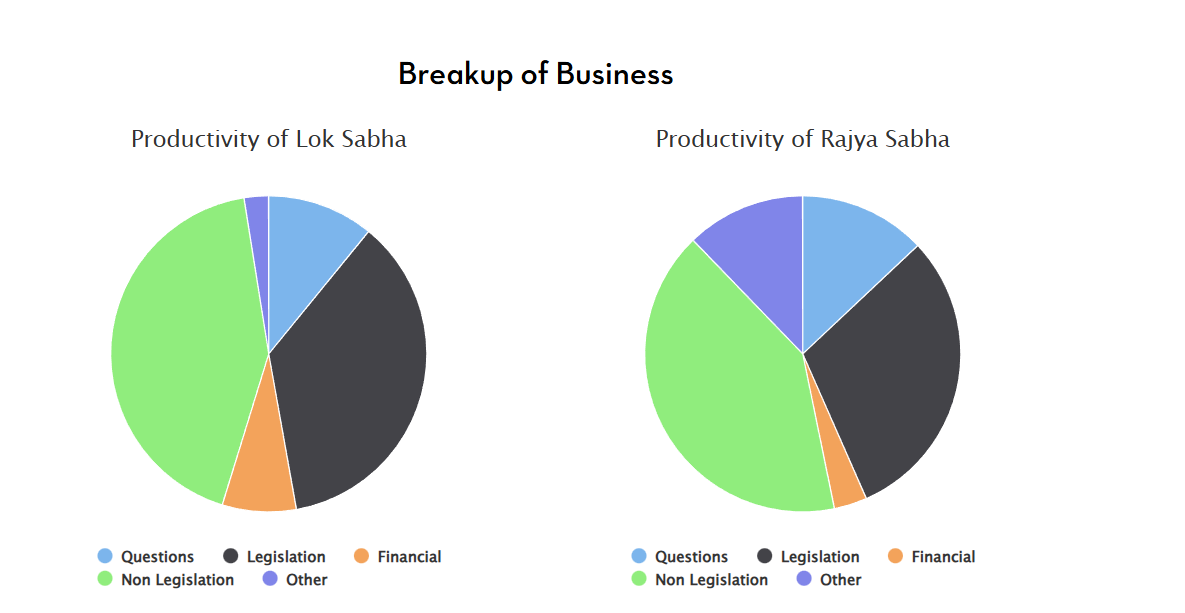
But buried under this legislative churn was one notification that barely got any attention, either inside Parliament or outside it. That is surprising, because this particular law touches almost every part of the Indian economy. India imports around 80 percent of its crude oil, and any reform of its value chain inevitably spills over into fertilizers, chemicals, transport, and manufacturing more broadly.
Which is exactly why it deserves a closer look, not just for what it promises to fix, but also to anticipate the unanticipated.
Oilfields (Regulation and Development) Amendment Act, 2025
The government has notified the new rules replacing the 1948 legislative architecture that governed India’s hydrocarbon sector for over seven decades and made this industry remarkably static. As with the rest of license raj across India, here too, there was a focus on regulatory control and licensing. So while the rest of the world’s energy landscape underwent tectonic shifts, from offshore deep-water exploration to the shale revolution and now decarbonization, India’s primary statute remained stuck in a post-independence licensing mindset.
The enactment of this amendment aims to transition the regulatory framework from a licensing-focused regime to one centered on the Ease of Doing Business and strategic energy security.
If a country seeks to empower domestic industry, the first and foremost thing to do is to provide them with a stable and predictable legal environment regardless of what its terms are. Businesses adapt to the framework they are given. Some scale up, some remain small, some move into informality. But investment and planning decisions are always shaped by legal certainty and incentive structures. People will always plan their future according to the incentives and the environment. This was inherently the issue with the previous laws.
Administrative and legal failures under the previous regimes
First and foremost, previously the definition of “mineral oils” was restrictive. It did not explicitly define or provide statutory rights for unconventional resources like shale gas, shale oil, or coal bed methane (CBM). There were ad-hoc “policy guidelines” rather than formal law to explore these. This mattered especially for firms like Exxon and Chevron, whose edge is fracking. Fracking is capex-heavy and technology-intensive, and without an actual law in place, no one is going to risk proprietary tech on a policy guideline. Unsurprisingly, they stayed away.
India is estimated to have 96 trillion cubic feet of shale gas and four billion barrels of shale oil that is considered technically recoverable (link)
Second, the previous law treated oil and gas extraction as a subset of traditional solid mineral mining. This ignored the unique risks and technological complexity of petroleum operations. And because petroleum legally came under “mining”, states also had the power to tax them, allowing states to impose their own unique taxes and cesses. For businesses, this meant higher-than-necessary production costs that varied by state.
Third, like the rest of the mining industry, the licensing system became an obstacle course for firms to jump through. To begin with, once a discovery was made under a Petroleum Exploration License (PEL), they had to prove it was commercially viable, which is followed by a detailed plan that had to be submitted and approved. If the government disagreed on the technical or cost details, projects could remain stuck for years. You can guess how slow and rent-seeking this process could be.
Even after these approvals, operators were forced to submit an entirely fresh application to the state government to convert their exploration license into a Petroleum Mining Lease (PML) before they could begin production, effectively restarting the bureaucratic clock for the same geographical block. So basically you’d need to get a license to carry out geological surveys, test drilling, etc., and then another license to carry out actual mining of hydrocarbons from the same piece of land.
And all this licensing provided a lease for a period of 20 years. If a field still had oil after 20 years, companies had to navigate a cumbersome renewal process with no guarantee of keeping the same terms.
As a side note, this system largely still exists for the mining sector today, even though petroleum has now been carved out.
Then there were the rule-of-law problems. There was no clear method to value oilfields for stamp duty, so states often tried to tax future, unproduced oil upfront. ONGC’s Ashoknagar discovery in West Bengal is a textbook case. Discovered in 2018, stalled for years over tax valuation disputes.
Beyond the administrative burden, the old framework suffered from weak contract enforcement. This meant the government could retrospectively modify lease conditions, which it has a long and well-documented affection for. Vodafone and Cairn learned this the hard way, and more recently Volkswagen has joined the list.

Besides this, there is the persistent absence of infrastructure, which often turned oil discoveries by smaller players into stranded assets when state monopolies denied access to pipelines or processing facilities. And hanging over all of this was the criminalization of even minor technical lapses, punishable by imprisonment.
The new Act attempts to clean up many of these structural failures, and in several places, it goes further than expected.
What has changed
The new petroleum lease replaces this mess with a single, unified “birth-to-death” permit. One lease now covers prospecting, exploration, development, production, and disposal. The number of approvals drops sharply from 37 to 18 (with 9 that could be done with self-certification), and mandates the lease applications to be decided within a strict 180-day window.
The definition of “mineral oils” is expanded to include any naturally occurring hydrocarbon, whether liquid, gas, or solid. This finally brings unconventional resources clearly within the law. Long-term leases of up to thirty years are now possible, extendable to the economic life of the field, allowing companies to plan investments properly.
The Act also tackles the stranded asset problem. Lessees must declare infrastructure capacity (installed and utilized) to the GoI and are allowed to share or jointly develop pipelines and facilities. This is aimed at reducing the problem of stranded assets.
Perhaps the most significant cultural shift is the complete decriminalization of operational matters. The Amendment replaces imprisonment with civil financial penalties. This continues the government’s broader push to decriminalize economic and compliance-related offences, as seen in recent labour law reforms.
To address the Vodafone/Cairn-esque fear of retrospective changes, the Act introduces a formal Stabilization Clause. It explicitly mandates that the terms and conditions of a petroleum lease shall remain stable and “shall not be altered to the disadvantage of the lessee” during the lease period. This provides the legal stability that firms require before sinking billions. This is the rule of law and contract enforcement that Ajay Shah and Amit Varma often talks about in their discussions.
The Ashoknagar-style valuation dispute is also fixed. Stamp duty is now based on total lease rent, not speculative future royalties. Royalties are paid only when oil is actually produced.
Oilfields as Energy Platforms
One underappreciated aspect of the Act is how deliberately it tries to navigate the energy transition rather than pretend hydrocarbons and clean energy live in separate worlds. By allowing Comprehensive Energy Projects, the law explicitly permits oil and gas leaseholders to deploy renewables, CCUS, and green hydrogen projects on the same geographical block.
This is important because the hardest part of scaling green hydrogen or carbon capture is infrastructure: land access, power connectivity, pipelines, ports, and skilled manpower. These are exactly the assets that already exist with oil firms. Allowing firms to reuse them lowers costs, shortens timelines.
This flexibility is valuable in the energy transition that will definitely be messy, non-linear, and highly capital intensive.
What remains unsettled
For all the clean-up the Act does, it does not magically eliminate political economy or federal tensions.
The stabilization clause is perhaps the most investor-friendly reform, but it will only be stress-tested during fiscal downturns. Stabilization clauses look robust in normal times. They are truly tested when oil prices crash, state finances come under pressure, or politics demands new revenue sources. Whether the Centre resists the temptation to reopen settled contracts remains an open question.
A major concern is federal taxation power. By shifting from mining leases to petroleum leases, the Act inevitably raises questions around states’ authority to tax mineral rights. There are worries that as petroleum is increasingly carved out from the mining framework and consolidated under a central petroleum lease regime, this could trigger fresh disputes over revenue, jurisdiction, and fiscal control. This tension is sharpened by the fact that the new Act gives the Centre control over oilfields. The Act may reduce friction for investors, but it does increase Centre–state conflict.
Then there is the environmental question. The move to decriminalize operational lapses is sensible from an investment and engineering perspective, but a fine of Rs 25 lakh may be treated simply as a cost of doing business. India would need stronger institutions to make sure this doesn’t happen.
Infrastructure sharing is another unresolved test. “Infrastructure sharing” sounds great on paper but I am not sure how it would actually take place. Let’s take pipeline sharing as an example.
Capacity constraints and quality mismatch are some issues that can pop up which are honestly nobody’s fault. But then there is also a basic incentive problem here. In most cases, the pipeline owner is a PSU that is also a direct competitor of the private firm seeking access. In this setup, high fees, scheduling issues, and consistently lower scheduling priority are some ways that the incumbents can use to make the process uneconomic for our smaller players.
And there is no fully neutral referee for disputes. They will be escalated to the same ministry that both promotes production and oversees PSUs. That is not an ideal place to resolve conflicts between a state-owned incumbent and a private challenger. The law does add some distance at the end of the process, and foreign investors get a neutral arbitration option, but this still stops short of a genuinely independent referee.
Whether this law is sufficient, or merely postpones a deeper midstream reform debate, is something we will only find out once real money and real discoveries are at stake.